
Contact

Toward Efficient and Accurate EMI Simulation in a Distributed-Memory Framework

I develop numerical methods and scientific software for cardiac electrophysiology. My research addresses a central computational challenge: how to resolve the electrical behavior of individual cardiac cells while retaining the scale, robustness, and reproducibility required for large simulations.

At the Zuse Institute Berlin, within the MICROCARD project, I work at the intersection of numerical analysis, high-performance computing, and computational physiology. My current focus is the three-dimensional Extracellular-Membrane-Intracellular (EMI) model and its realization in the open-source openCARP ecosystem.

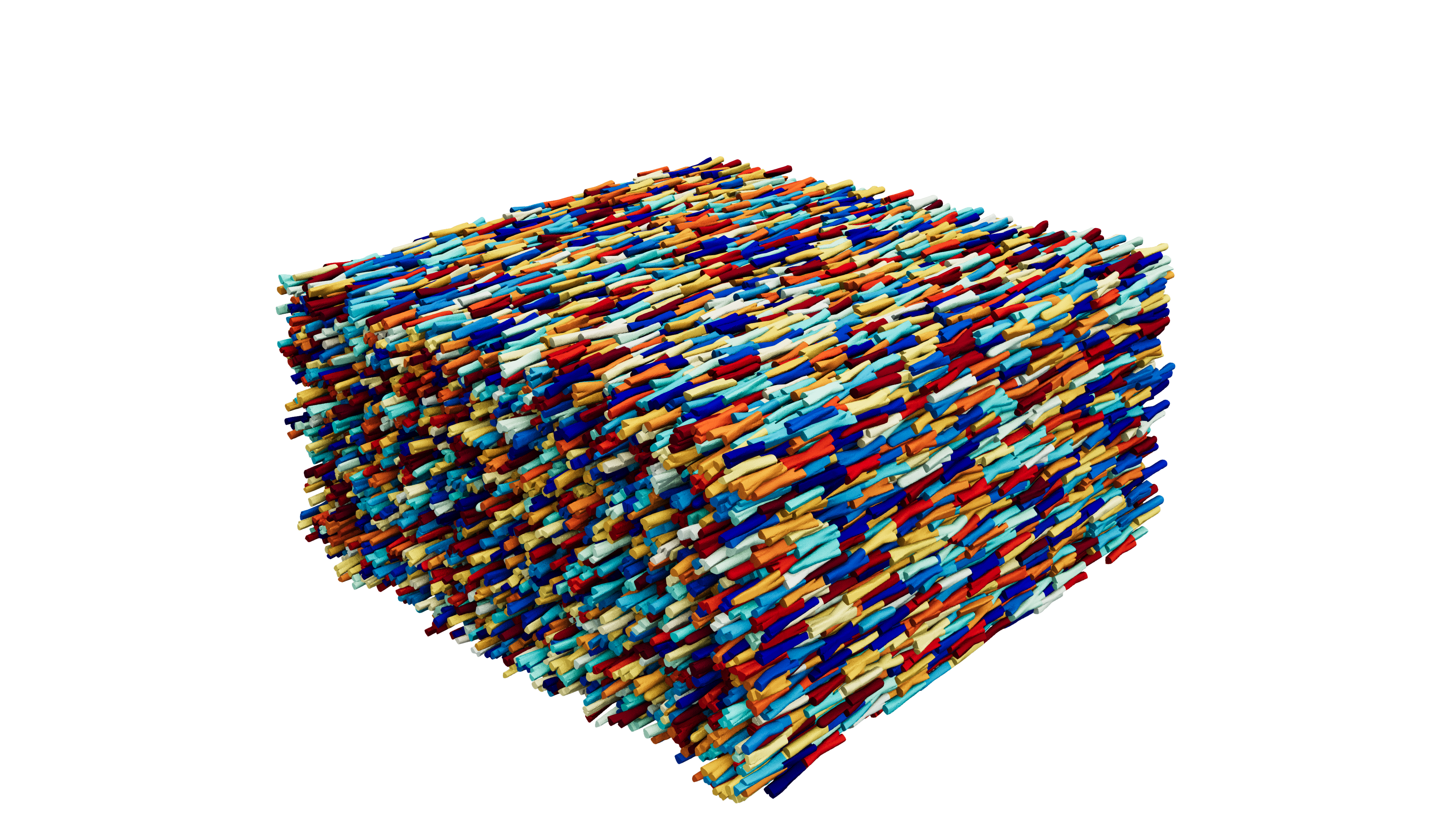
Cell-resolved EMI tissue block

This mesh was generated by Mark Potse for cellular-resolution cardiac electrophysiology simulations. The mesh-generation strategy is described in the associated paper.

Research themes

Distributed-memory EMI in openCARP

The starting point is a continuous cardiac tissue input mesh. To represent the Extracellular-Membrane-Intracellular (EMI) model, the mesh is transformed into a computational representation in which membrane interfaces are explicitly identified and the volume topology is decoupled across those interfaces.

Material and region tags provide the first partitioning information. The implementation derives the EMI mesh, reconstructs two-sided membrane-face links, assigns global and local indices on the decoupled interfaces, and builds the volume and surface data structures needed for assembly. From these structures, it constructs the mass, stiffness, membrane-coupling, and transfer operators, assembles the coupled system, and advances the solution with a semi-implicit time-integration workflow.

The openCARP EMI implementation integrates both the PETSc and Ginkgo solver libraries. PETSc provides a mature distributed-memory framework for sparse systems, Krylov methods, and multilevel preconditioning, while Ginkgo provides a modern C++ linear-algebra backend suited to manycore and GPU-oriented experiments. This dual-backend design lets the same EMI formulation be evaluated across different solver and hardware environments.

The work is part of the MICROCARD-2 project and is developed as an open-source contribution to openCARP.

Higher-order FEM & algebraic adaptivity

Higher-order finite elements improve the approximation of the cardiac fields, but activating every higher-order degree of freedom can be unnecessarily expensive. I use hierarchical finite-element spaces and multilevel preconditioning to separate the lower-order vertex unknowns from the higher-order edge unknowns.

The algebraic adaptivity strategy selects where second-order degrees of freedom are needed and turns them on or off according to the local numerical requirements. This produces an algebraically adapted system: the solver retains a consistent hierarchy while concentrating higher-order work in the parts of the mesh where it improves accuracy most. The first-order and second-order blocks can then be treated with different preconditioning strategies.

Selected experiments report empirical convergence orders of approximately 0.97 for P1 and 1.73 for P2 in the tested hierarchy, illustrating the accuracy benefit of activating higher-order structure where it is useful.

Spectral Deferred Correction

Spectral Deferred Correction (SDC) provides higher-order time integration by applying a sequence of correction sweeps to a lower-order provisional solution. In cardiac excitation, this makes it possible to increase temporal accuracy while reusing the structure of the underlying spatial discretization and implicit solver.

I combine SDC with algebraic adaptivity so that later correction sweeps focus on active degrees of freedom instead of repeatedly treating the full system. This reduces unnecessary work while preserving the higher-order correction process, and it connects naturally to multilevel preconditioning and domain-decomposition methods.

In selected experiments, restricting later correction sweeps to active degree-of-freedom subsets produced speedups of approximately 5-8 compared with processing the full system at every stage.

BDDC & scalable preconditioning

BDDC is a domain-decomposition preconditioner for the large linear systems produced by EMI discretizations. The mesh is divided into subdomains, local problems are solved independently, and carefully selected interface constraints provide global coordination and scalability.

In my work, BDDC is combined with SDC and algebraic adaptivity. The active subset of degrees of freedom can change between correction stages, while the multilevel structure is used to avoid unnecessary refactorization and to keep the preconditioner effective as the problem evolves. This is important when high-order unknowns or active subdomains are switched on and off during the computation.

The implementation has been evaluated on large EMI systems, including strong-scaling studies with approximately 302 million decoupled volume degrees of freedom and 272 million unique membrane faces, as well as GPU-oriented weak-scaling experiments with Ginkgo on NVIDIA GH200 systems.

Communication compression

In distributed BDDC, interface vectors are exchanged between neighboring subdomains and can become a communication bottleneck. I study a block-oriented compression pipeline that organizes interface data into compressible blocks before encoding and transmitting them.

The approach combines transform-based representations, quantization, variable-length bitstreams, and entropy coding such as Huffman coding. Graph-based lifting can expose structure in unstructured interface data before compression. The objective is to reduce exchanged data while controlling the numerical error introduced into the preconditioner and preserving scalable convergence.

Inverse cardiac electrophysiology

Detection and quantification of myocardial scars are important for diagnosing heart disease and constructing personalized cardiac simulation models. Scar tissue changes excitation conduction, so the inverse problem estimates conductivity-related parameters from endocardial mapping data.

The estimation minimizes the mismatch between simulated and measured electrical activity on the endocardial surface, subject to the monodomain model and regularization. Because fine-grid monodomain simulations are expensive, I combined monodomain and eikonal model hierarchies with recursive multilevel trust-region optimization. The work compared adjoint-gradient methods, steepest descent, limited-memory BFGS, and multilevel approaches for scar reconstruction and maximum-posterior estimation.

The implementation extended heart, used libMesh, and integrated with Utopia. During the PhD, I was part of the Center for Computational Medicine in Cardiology (CCMC) at USI.